
Are you searching for the best open concept kitchen living room layouts to create a space that is airy, connected, and perfectly functional? The open floor plan has revolutionized modern living, breaking down walls to create expansive “great rooms” where cooking, dining, and relaxing can all happen in one cohesive space. This layout is celebrated for its social atmosphere and its bright, spacious feel. However, it also presents a unique design challenge: how to create distinct, functional zones without physical walls, ensuring your living room doesn’t feel like an extension of your kitchen’s work area.
This guide will provide you with 19 of the best layout ideas, from using islands and sofas as dividers to incorporating partial walls and changes in level, to help you design a beautiful and highly functional open-concept home.
1. The Classic Island as a Room Divider
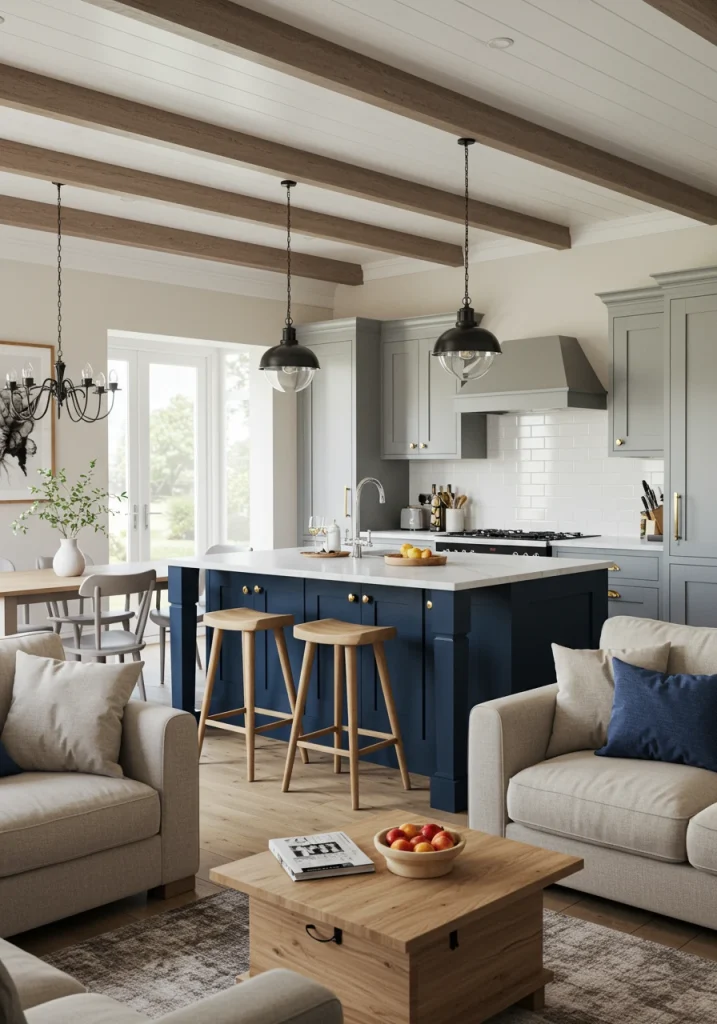
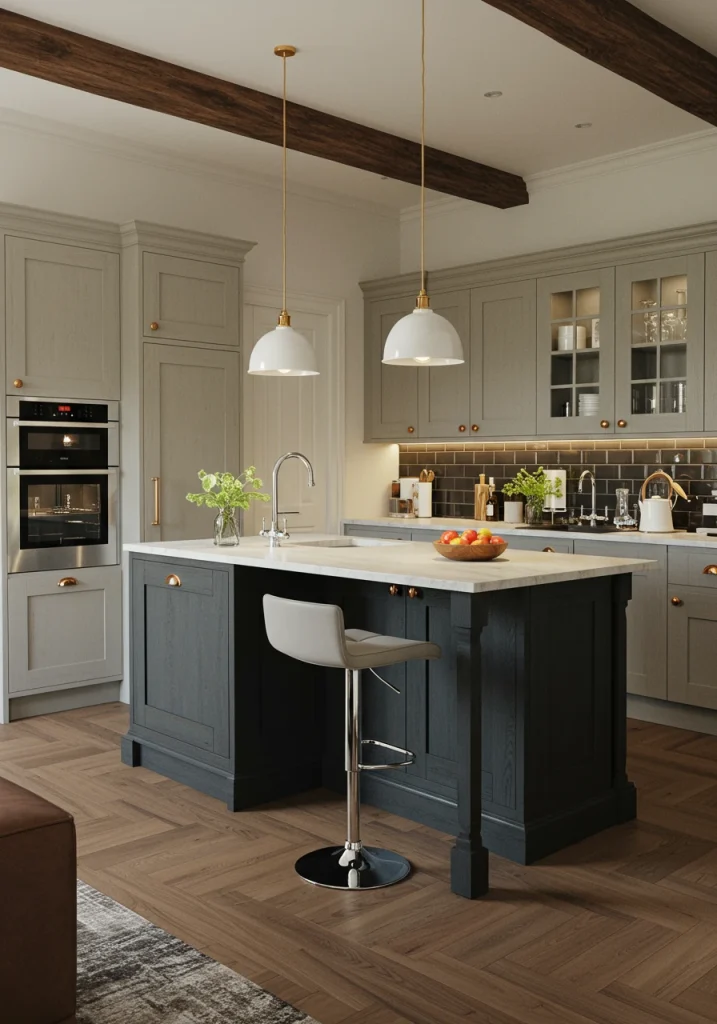
The kitchen island is the single most effective and popular tool for creating a clear, functional, and social division in an open-concept space. As seen in your reference images, an island acts as a natural boundary for the kitchen’s “work zone” while simultaneously serving as a social bridge to the living area, especially when it includes seating. It provides extra counter space, a casual dining spot, and a place for guests to gather and chat with the cook without getting in the way.
I always tell my clients that a well-designed island is the first element to consider. It is the hardworking anchor of the entire great room.
- Function: Provides a work surface, storage, casual dining, and a clear visual divider.
- Seating: Stools on the living room side create a social hub.
- Style: The design of the island (e.g., waterfall countertop, decorative paneling) can set the tone for the entire space.
For an enhancement, choose a different, more dramatic color for your island cabinetry than the rest of your kitchen cabinets. This will make the island stand out as a beautiful, intentional, furniture-like piece that clearly defines the transition between the two zones.
2. Anchor the Living Zone with a Large Area Rug
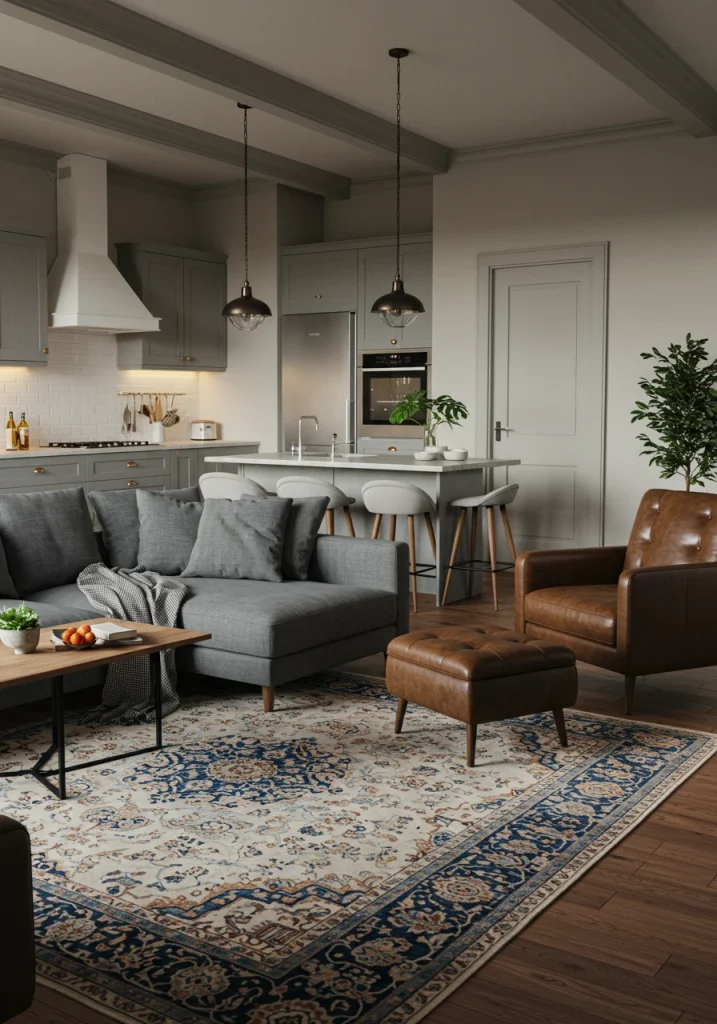
The easiest and most effective way to define your living room zone within a larger open space is with a large area rug. A rug acts as a visual “island” that anchors your sofa, chairs, and coffee table, grouping them together into a cohesive and intentional seating area. This simple addition, as showcased in many of your reference photos, makes the living room feel like a distinct “room” without building any walls, creating a cozier and more intimate atmosphere.
The most common mistake homeowners make is choosing a rug that is too small. For a successful layout, the rug should be large enough that at least the front legs of all your main seating pieces are resting on it. As the experts at HGTV often advise, a generously sized rug is crucial for making a furniture grouping feel grounded.
- Function: Visually defines the living room zone and adds softness, color, and texture.
- Size is Key: Must be large enough to connect the main seating pieces.
- Placement: The front legs of the sofa and any chairs should be on the rug.
For an enhancement, choose a rug with a bold pattern or a rich color. In a large, neutral open-plan space, the living room rug is a perfect opportunity to inject a major dose of personality and style.
3. The Sofa and Console Table Divider
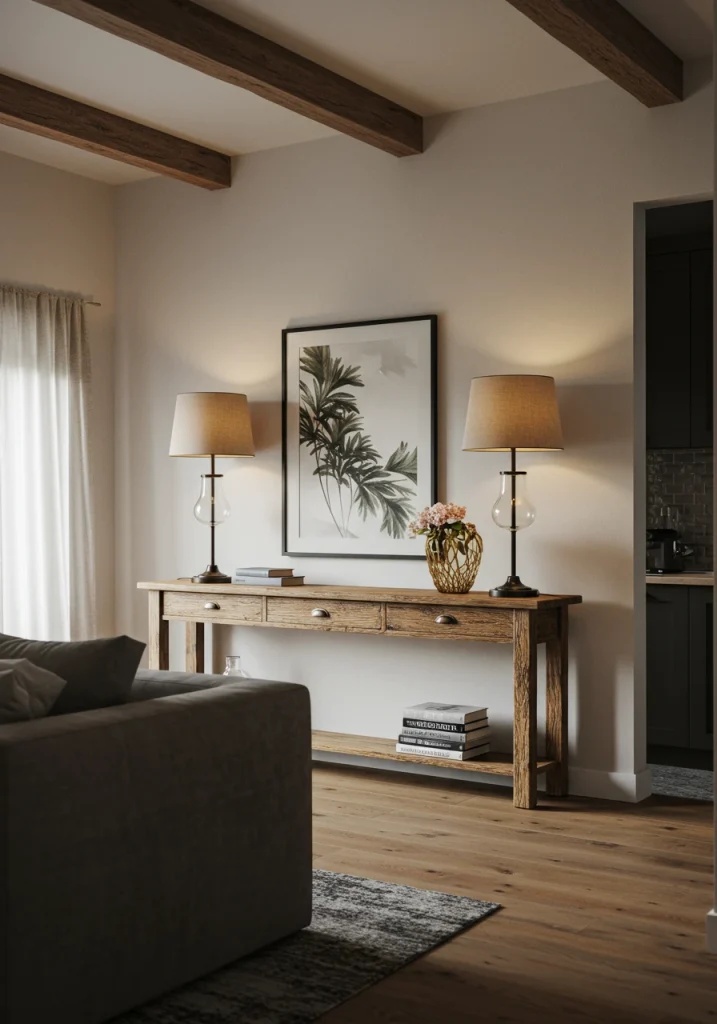
In an open-plan layout, the back of your sofa is often exposed and can become a de facto wall. Instead of leaving it bare, placing a slim console table directly against the back of the sofa is a brilliantly smart and stylish way to create a clean, finished border between your living and kitchen/dining zones. This simple addition turns the back of your sofa into a beautiful, functional feature.
This is my go-to trick for making a “floating” sofa feel intentional and for adding function to the middle of a room. The console table provides a perfect surface for placing a pair of matching table lamps, which can add much-needed ambient light. It’s also a great spot for displaying decorative objects or a vase of flowers.
- Function: Creates a visual and physical border, provides a surface for lighting and decor.
- Placement: The console should be roughly the same height as the back of the sofa and slightly less wide.
- Style: Choose a console in a style and material that complements both the kitchen and living room decor.
For an enhancement that adds function, tuck two small, upholstered stools or ottomans underneath the console table. They will be completely out of the way for daily use but can be pulled out as extra seating when you have guests.
4. Use Consistent Flooring to Connect the Spaces
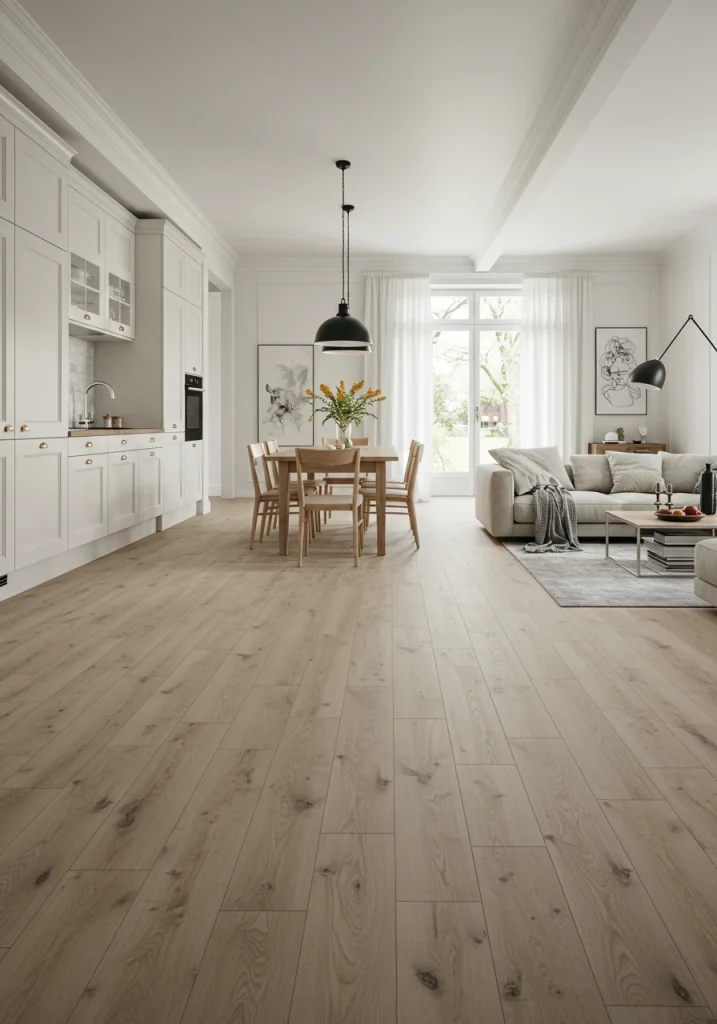
One of the most important decisions you can make to ensure your living room kitchen combo feels like one large, unified space is to use the same flooring material throughout. Running a single, uninterrupted flooring material—like hardwood, laminate, or large-format tile—from the kitchen through the dining area and into the living room creates a seamless visual foundation. Abruptly changing the flooring at the edge of the kitchen can visually chop up the space and make it feel smaller and more disjointed.
As a designer, this is one of my non-negotiable rules for a successful open plan. A continuous floor allows the eye to travel across the entire space without interruption, which is key to creating that expansive, airy feeling. Modern materials like luxury vinyl plank (LVP) and wood-look porcelain tile are fantastic choices.
- Creates Flow: A single flooring material is the key to a seamless, unified space.
- Makes Space Feel Larger: Unbroken lines on the floor make the entire area feel more expansive.
- Durable Choices: Choose a material that is durable enough for the kitchen but also warm and comfortable enough for the living room.
For an enhancement, if you use a wood or wood-look flooring, pay attention to the direction you lay the planks. Running the planks parallel to the longest dimension of the room will further enhance the sense of space and flow.
5. The L-Shaped Kitchen with a Peninsula
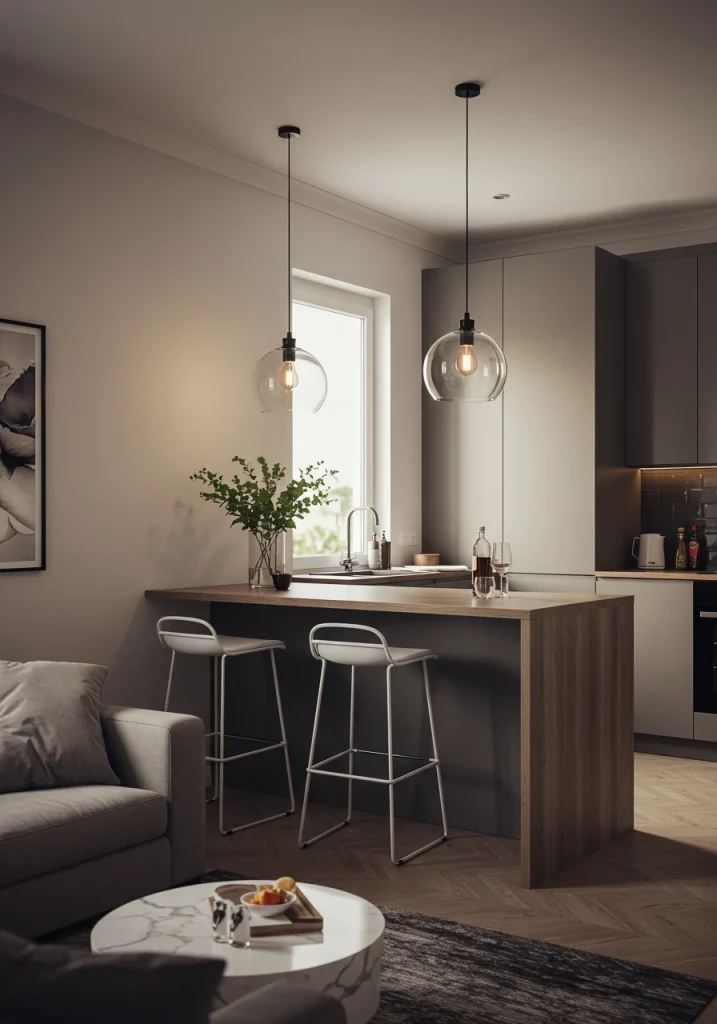
If your space is not quite large enough for a full island, a kitchen peninsula is a brilliantly effective and space-saving alternative for dividing your kitchen and living room. A peninsula is a counter that is attached to a wall on one end and juts out into the open space. It provides many of the same benefits as an island—extra counter space, a spot for casual seating, and a clear visual divider—but it only requires you to have walkway access on three sides instead of four.
I often recommend a peninsula for smaller, L-shaped kitchen layouts in an open plan. It creates a gentle, “C-shaped” enclosure for the kitchen that feels defined but not closed off. As often seen in apartment and smaller home designs, it’s a very efficient use of space.
- Space-Saving: A great alternative to an island in a smaller or narrower open-plan room.
- Defines the Kitchen: Creates a clear but not solid barrier between the kitchen and living areas.
- Provides Seating: Adding an overhang to the counter on the living room side allows for bar stool seating.
For an enhancement, install a pair of beautiful, statement pendant lights over your peninsula. This will not only provide excellent task lighting but will also visually reinforce the peninsula as a key transitional zone.
6. Create a Cohesive Lighting Plan
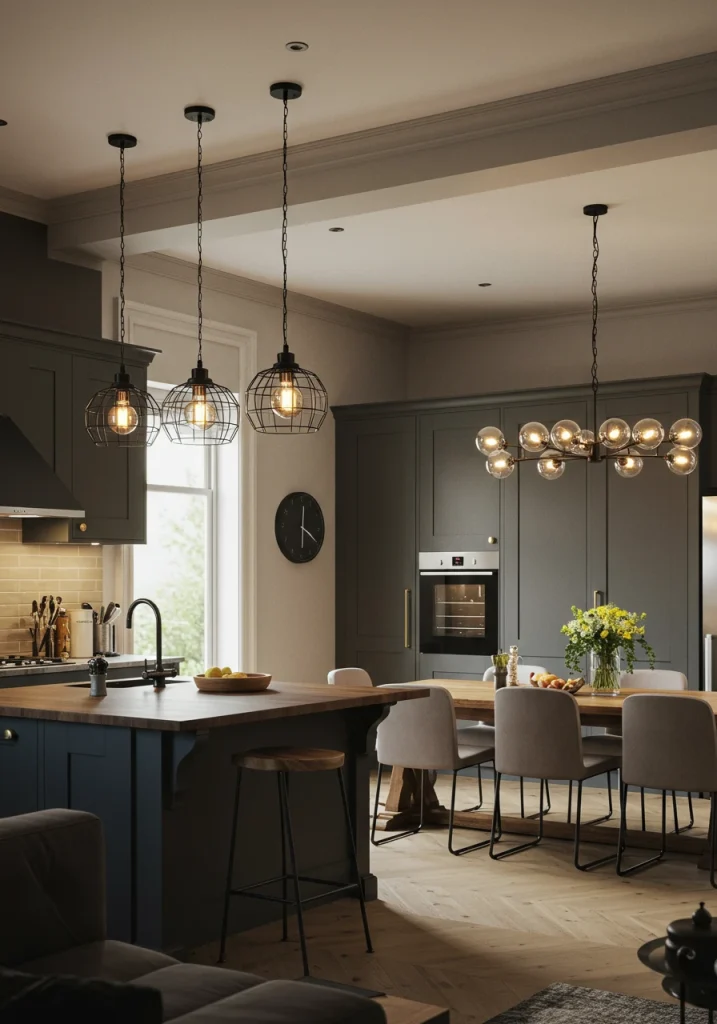
In an open-concept space, your lighting plan needs to be considered as a whole, not as separate plans for each zone. A cohesive lighting plan will not only provide the right kind of light for each functional area but will also help to unify the entire space. The style of your light fixtures should be consistent or complementary across both the kitchen and the living room.
You need to incorporate layers of light in each zone. I always tell my clients to choose fixtures that share a common style, finish, or shape.
- Kitchen: Requires bright task lighting (pendants over the island, under-cabinet lights).
- Living Room: Requires softer, ambient light (from a central fixture or lamps) and task lighting (a reading lamp).
- Cohesion: For example, the brass pendant lights over your kitchen island could be complemented by a brass floor lamp in your living room.
For a dramatic enhancement, use a large, statement chandelier over your living room seating area. This will create a powerful focal point and clearly anchor the living zone, giving it a sense of importance and place within the larger open room.
7. The “Broken-Plan” with a See-Through Fireplace
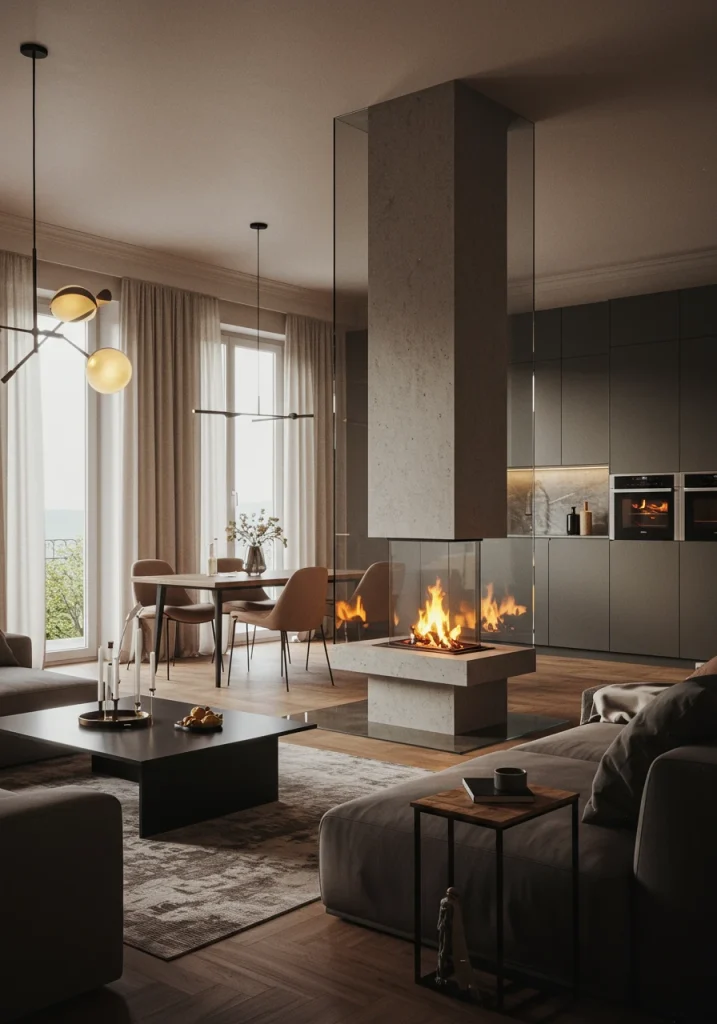
For those who find a fully open-concept space a bit too noisy or exposed, the “broken-plan” layout is a brilliantly creative solution. This is a design concept that represents a middle ground, keeping the visual connection and flow of an open plan but using clever, partial dividers to create a greater sense of separation and intimacy.
A large, double-sided, see-through fireplace is the ultimate divider for a broken-plan layout. It creates a stunning, architectural feature that can be enjoyed from both the kitchen and the living room, while the structure of the fireplace surround creates a clear and substantial division of space. As a designer, I love this approach because it offers the best of both worlds.
- Best of Both Worlds: The light and flow of an open plan, with the privacy and definition of a closed plan.
- The Divider: A double-sided, see-through fireplace is a luxurious and highly effective choice.
- Effect: Creates defined zones that are still visually connected by the shared feature of the fire.
For an enhancement, build low, integrated bookshelves or storage cabinets into the base of the fireplace surround on either side. This will add even more function to your beautiful, architectural divider.
8. Using Columns or Cased Openings
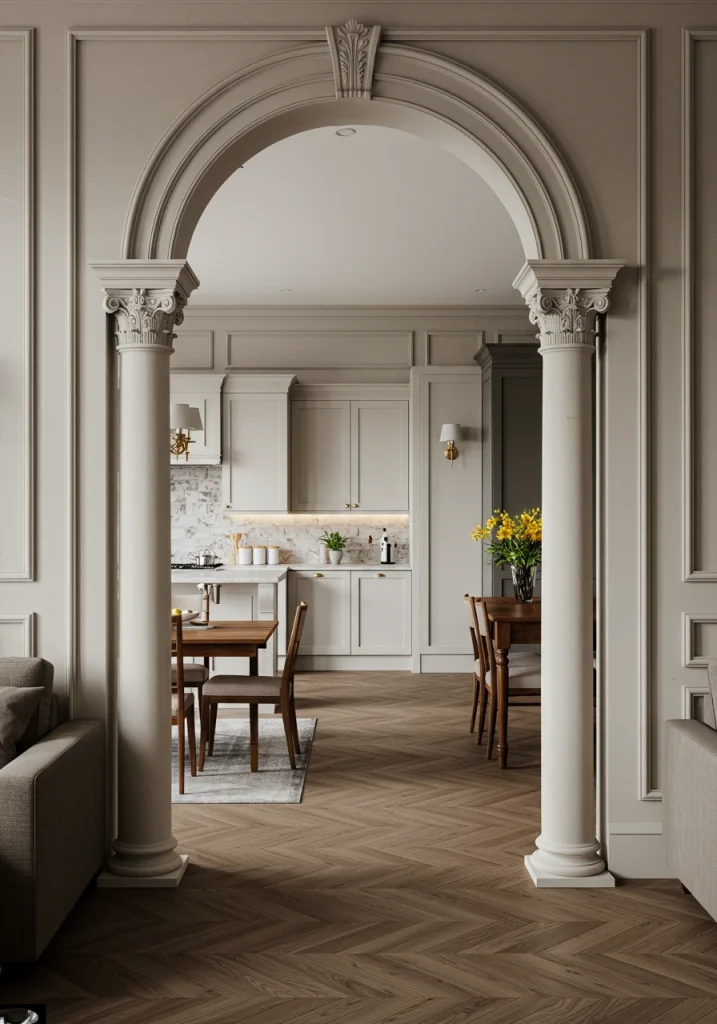
If you want a sense of separation that is more traditional and architectural, you can use columns or a wide, cased opening to create a graceful threshold between the kitchen and the living room. This is a classic design solution that is often found in older homes that have been opened up. It allows you to remove the walls while still leaving a hint of the original, separate rooms.
I love this technique for adding a touch of classic character to a modern, open plan. The columns or the wide, trimmed opening act as a beautiful, formal frame between the two spaces.
- Half-Wall with Columns: A half-wall topped with a decorative column can create a beautiful and substantial divider.
- Cased Openings: A wide opening between the two spaces that is finished with beautiful, decorative trim or molding.
- Effect: Gives the feeling of two distinct rooms while preserving the open, airy feel and flow.
For an enhancement, build low, half-height bookcases on either side of your cased opening. This will further reinforce the sense of a grand, library-like threshold between the two spaces.
9. The Galley Kitchen Pass-Through
In some open-plan layouts, especially in apartments or narrower homes, the kitchen is a “galley” style, with two parallel walls. An innovative layout is to make one of these “walls” a large, open pass-through that opens up to the living room. This can be achieved with a long peninsula or an island that has a raised, bar-height back.
This design keeps the kitchen’s main work triangle contained and efficient but opens up the view and creates a social connection to the living area. I love this layout for its combination of efficiency and openness.
- Contained Workspace: Keeps the main kitchen functions separate.
- Social Connection: The pass-through or bar is the perfect spot for guests to sit and chat.
- Space-Efficient: A great layout for long, narrow, open-plan rooms.
For an enhancement, use a different material for the raised, bar-height portion of your pass-through. For example, if your main kitchen counters are a simple quartz, you could use a thick, beautiful, reclaimed wood slab for the bar top. This will make it feel like a special, designated, social feature.
10. Repeat Materials and Finishes
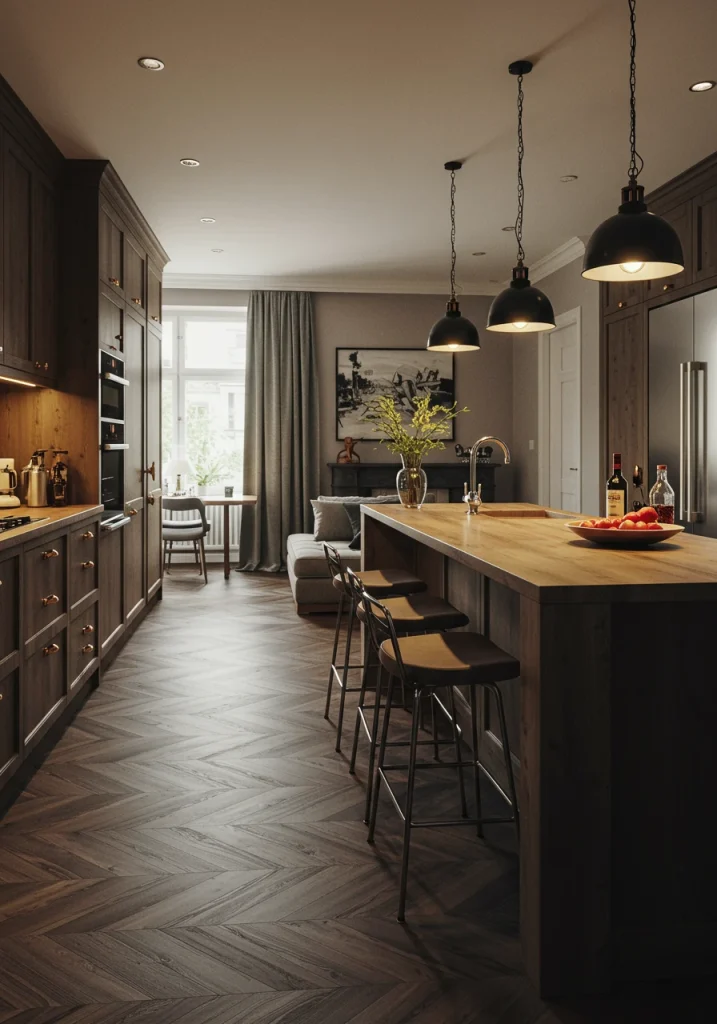
Beyond just color, repeating key materials and finishes throughout your open-plan space is another powerful strategy for creating a cohesive and intentional design. This is about creating a subtle but effective visual dialogue between the kitchen and living room zones. By using the same wood tone, metal finish, or stone type in both areas, you create a sense of rhythm and harmony.
This is a trick I use in all my open-concept projects. For example, if you have open shelving made of warm walnut in your kitchen, use a media console or a coffee table in the same warm walnut in your living room. If you choose a sleek, matte black finish for your kitchen faucet, repeat that same matte black in the frame of a mirror in the living area.
- Wood Tones: Match the wood of your kitchen island to a piece of furniture in the living room.
- Metal Finishes: Repeat the finish of your kitchen hardware (brass, black, nickel) in your living room lighting and accessories.
- Stone: The marble of your kitchen countertop could be echoed in the top of a small side table.
For an enhancement, use a material in an unexpected way. For instance, clad the front of your kitchen island in the same reclaimed wood that you used for a feature wall or floating shelves in your living room. This creates a very strong and custom-looking connection.
11. The U-Shaped Kitchen Boundary
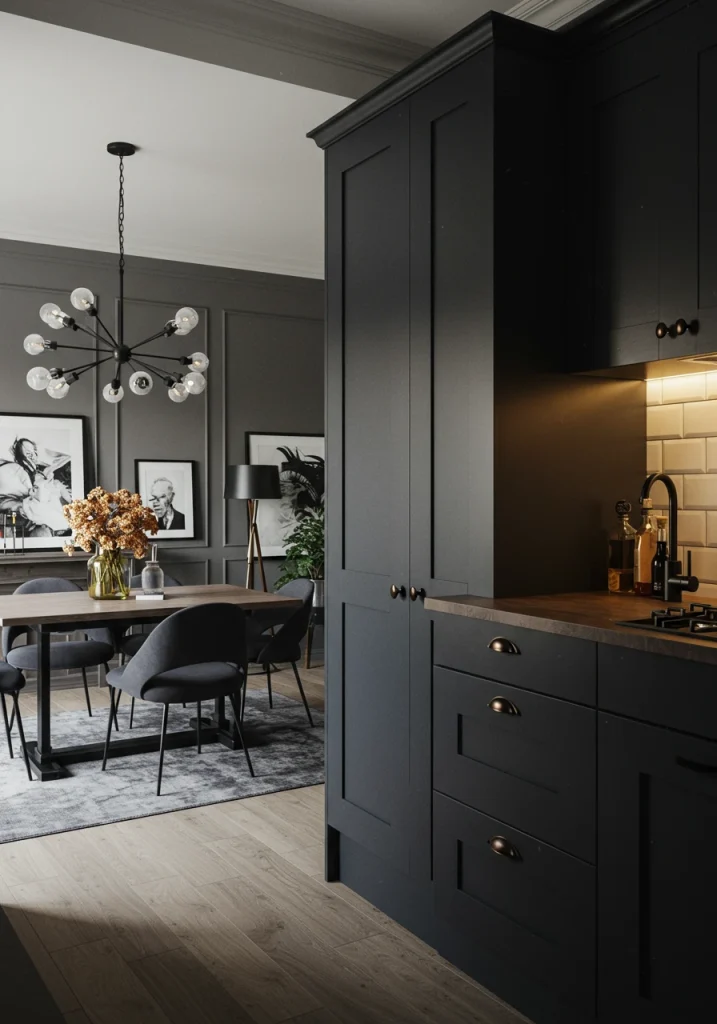
A U-shaped kitchen is a classic, highly efficient layout that can also be a fantastic way to define your kitchen zone in an open-plan home. The three walls of cabinetry and countertops create a very clear, contained workspace. In an open-concept design, one of the “legs” of the U is typically a peninsula that opens up to the living or dining area, often with seating.
This layout is celebrated by chefs and home cooks for its incredible functionality. Everything is within a few steps in the classic “work triangle.” I love how it creates a very clear boundary for the kitchen, keeping guests and family members from wandering into the main cooking zone, while still keeping the space socially connected.
- Highly Functional: The classic, ergonomic work triangle.
- Clear Definition: The U-shape creates a very clear and contained kitchen zone.
- Social Connection: One leg of the U is typically a peninsula that opens to the living area.
For an enhancement, make the peninsula leg of your U a different color or material from the other two walls of cabinetry. This will emphasize it as the main, transitional, and social element of the kitchen.
12. The “Floating” Sofa and Main Walkway Layout
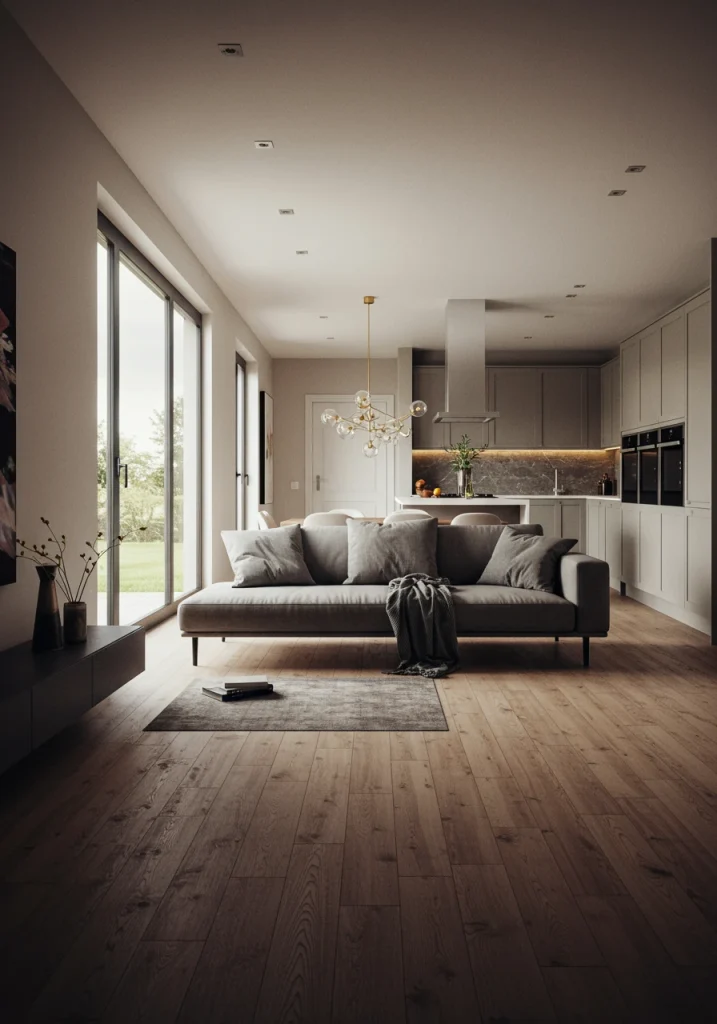
In many long, open-plan rooms, the most direct path from one end to the other is right through the middle, forcing you to walk around the furniture. A smart layout is to embrace this and create one clear, dedicated walkway along one of the “walls” of your open space. To do this, you “float” your main sofa and seating arrangement in the middle of the room, pulled away from the main traffic path. This creates an unobstructed “traffic lane” on one side and a cozy, contained seating area on the other.
This layout is incredibly effective at solving the traffic problem in an open-concept home. I often use this layout where the kitchen is on one side of the room. The walkway is then created between the kitchen island and the back of the floating sofa. This makes the seating area feel intentional and intimate.
- Float the Sofa: Pull the main sofa away from the wall into the center of the room.
- Create a Walkway: Leave a clear path of at least 36-48 inches for a main traffic path.
- Anchor with a Rug: Place a large area rug under your floating furniture arrangement to define the seating zone.
To enhance this layout, place a long, slim console table against the back of the floating sofa. This provides a beautiful, finished look and a surface for lamps, books, and decor, creating a stylish “entry” to the seating area.
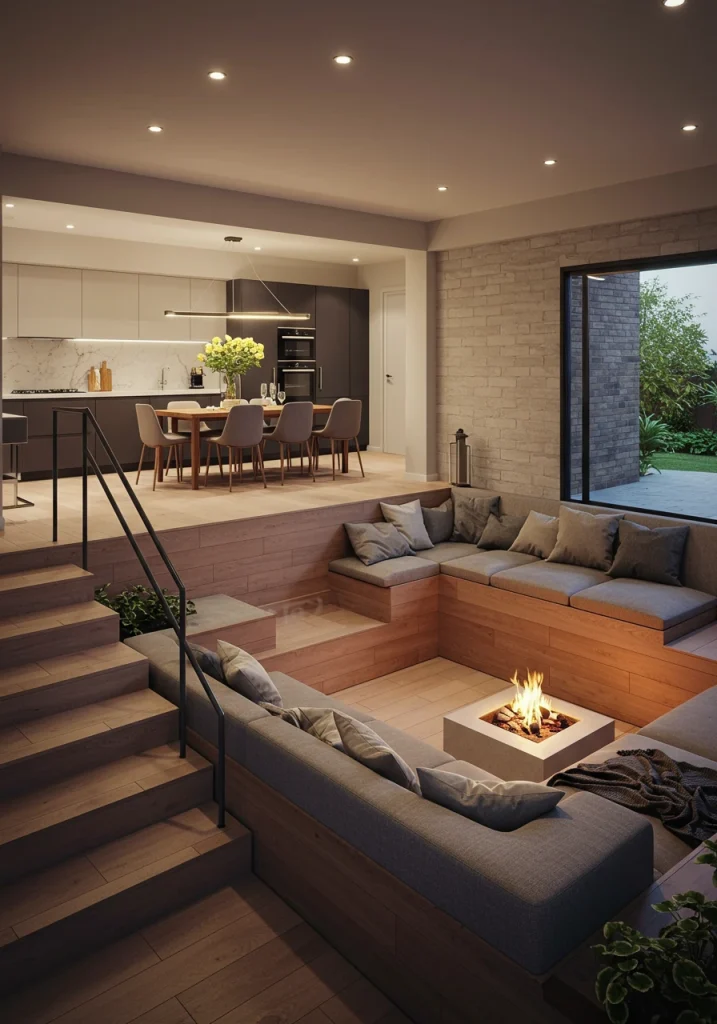
13. Create a Sunken Living Room
To create a very clear, architectural, and dramatic division between your kitchen and your living room, consider a sunken living room. This is a more ambitious, renovation-focused layout, but it has an incredibly high-impact, custom feel. By lowering the floor level of your living room by just one or two steps, you create a very distinct, cozy, and contained “conversation pit.”
This is one of my favorite creative solutions for a large, open-plan space. The change in elevation provides a powerful sense of arrival and enclosure for the living zone, while still maintaining the open, visual connection to the kitchen.
- Excavation: You’ll need to lower the floor by 12-24 inches to create the sunken effect.
- Architectural Drama: The change in level is a powerful, high-end design statement.
- Cozy and Contained: A sunken room has a naturally intimate and enveloping feel.
For an enhancement, build a low, custom, L-shaped sofa directly into the sunken perimeter. This will maximize the seating and will enhance the clean, architectural, and custom-designed feel of the space.
14. The Back-to-Back Sofa Divide
This is a bold and highly effective layout for a very large, open-concept great room where you truly want to create two, completely separate functional zones. In this arrangement, two identical sofas are placed back-to-back, floating in the middle of the room. One sofa faces into the living room zone, perhaps towards a fireplace or a TV. The other sofa faces the other direction, creating a secondary seating area or a clear boundary for the dining or kitchen zone.
This is a very high-impact layout that I have used in large, open loft-style homes. It’s the ultimate way to create two, distinct seating areas in one, large space.
- Best For: Very large, long, or open-plan great rooms.
- Pros: Creates two completely separate and highly functional seating zones.
- Cons: Requires a very large amount of space and two sofas.
To enhance this layout and connect the two zones, place a long, slim console table between the two back-to-back sofas. This creates a beautiful, finished look and provides a perfect surface for a pair of matching lamps, which will provide light to both sides of the room.
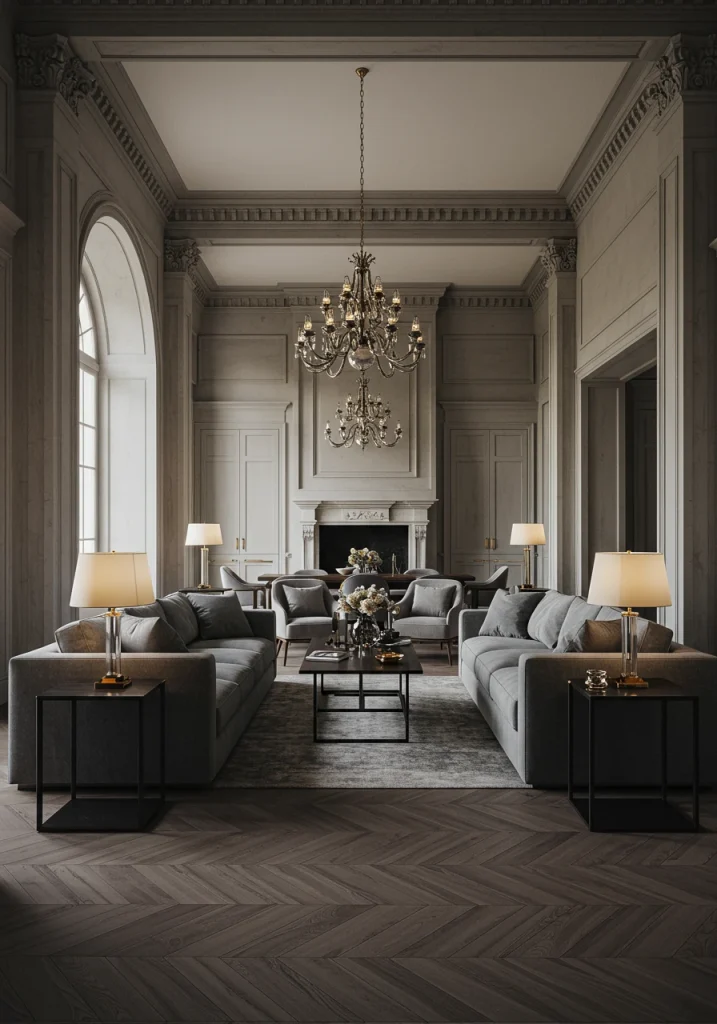
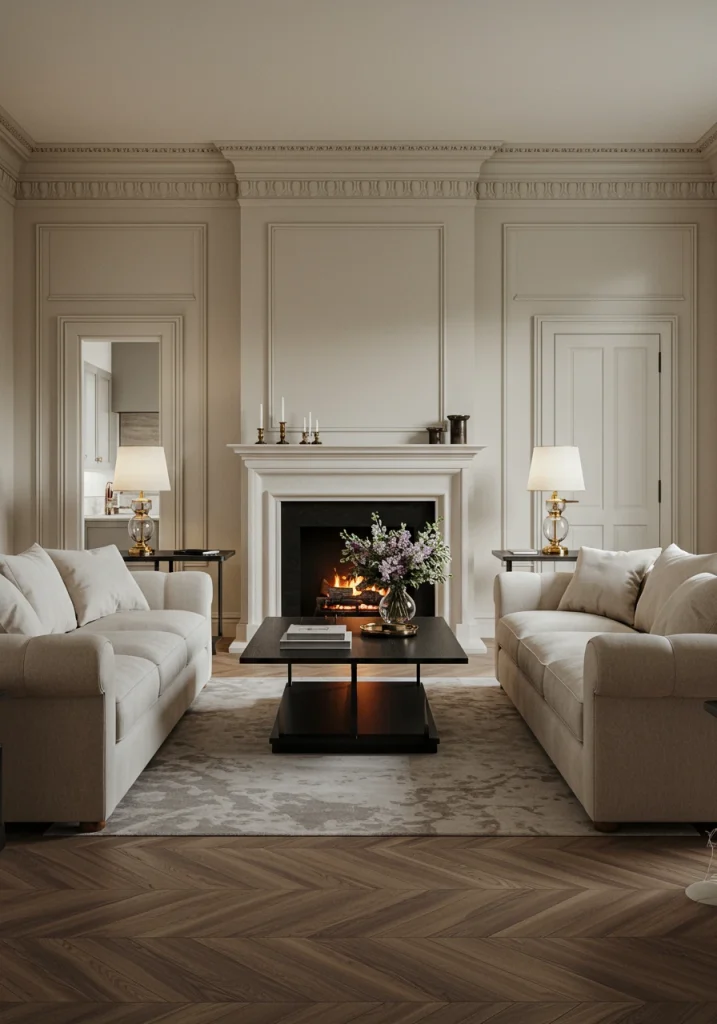
15. The Symmetrical Conversation Pit
For a more formal, classic, and beautifully balanced open-plan living room, a symmetrical layout is a timeless choice. In this arrangement, a central focal point, like a fireplace or a large piece of art, is the anchor. Then, two identical sofas or loveseats are placed directly facing each other, perpendicular to the main sightline from the kitchen. This creates a powerful, elegant, and defined conversation zone.
This layout is perfect for homeowners who prioritize formal entertaining and conversation. The perfect symmetry, as often seen in the pages of Architectural Digest, creates a sense of calm and formal order, and the open ends of the seating group keep it from feeling closed off from the rest of the open plan.
- Best For: Formal living areas within an open plan.
- Furniture: Use two identical sofas or loveseats to create the perfect symmetry.
- Effect: Creates a very elegant, balanced, and formal conversation area.
For an enhancement, use a large, striking area rug that is big enough for both sofas to have all their legs on it. This will unify the entire seating arrangement and make it feel even more grand and cohesive.
16. Use a See-Through Bookcase as a Screen
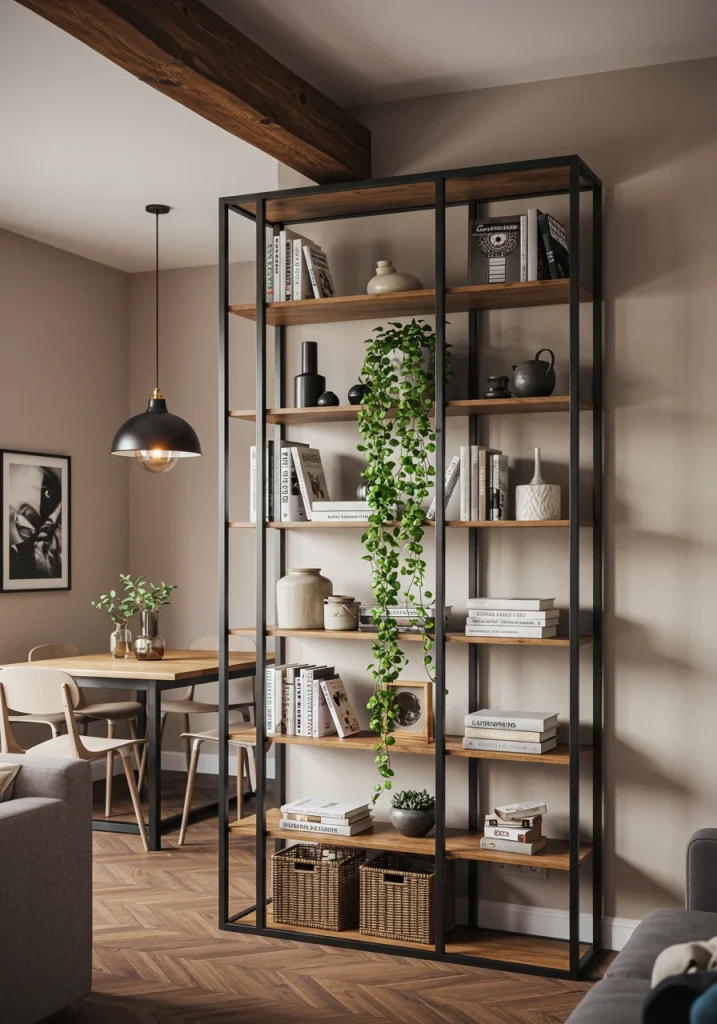
For a divider that is functional, stylish, and maintains an open, airy feel, a tall, open-backed shelving unit or bookcase is a perfect choice. This type of furniture acts as a visual screen, creating a clear sense of separation between your kitchen and living room zones, but because you can see through it, it doesn’t block light or sightlines. This is a favorite solution in small, open-plan apartments and homes.
This is a wonderfully flexible solution. You can style the shelves with a mix of books, plants, and decorative objects. I always advise my clients to not over-clutter the shelves. Leaving plenty of “negative space” is key to maintaining that light and airy feeling.
- Flexible Division: Creates separation without building a wall.
- Maintains Openness: Doesn’t block light or the view.
- Provides Storage and Display: A hardworking, functional piece of furniture.
As an enhancement, use a bookcase with an interesting, asymmetrical, or geometric shelving pattern. This will make the divider feel more like a sculptural piece of modern art.
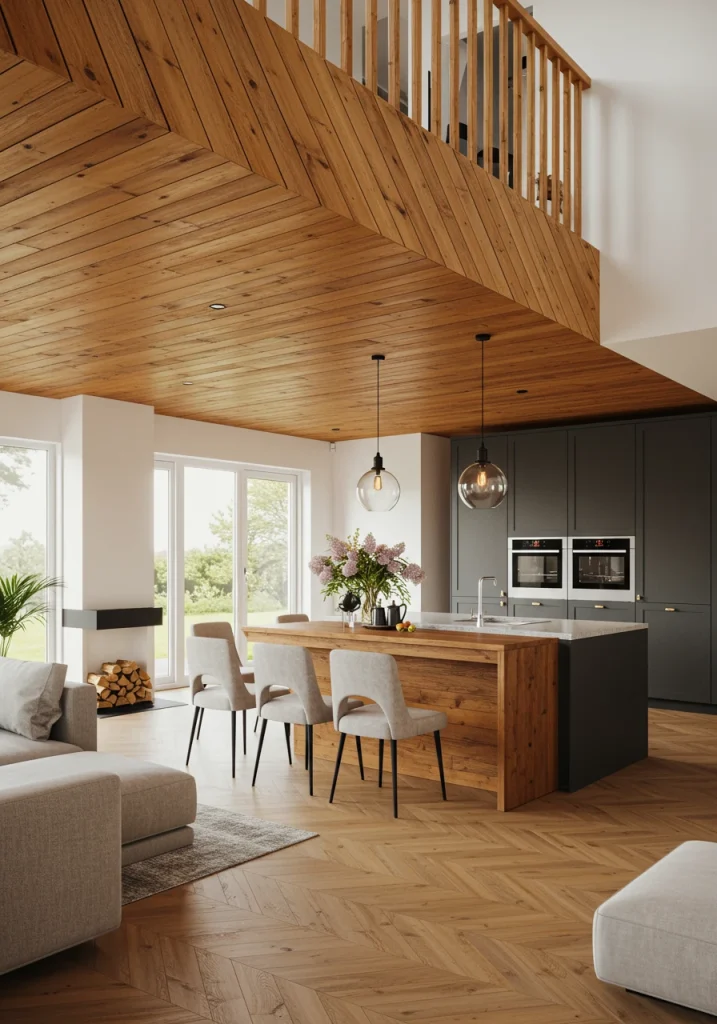
17. Create a Dropped Ceiling or Soffit
A very clever and high-end, architectural way to create a sense of definition and intimacy in an open-plan space is to use a dropped ceiling or a soffit over one of your zones. By lowering the ceiling height over just the kitchen area, for example, you can create a clear, architectural boundary that makes the kitchen feel more contained and the adjacent living room, with its higher ceiling, feel even more open and expansive.
This is a technique that I use in new builds and major renovations to add architectural interest to a large, flat, open-concept ceiling.
- Defines the Zone: A lower ceiling over the kitchen clearly delineates it as a separate, functional area.
- Adds Architectural Interest: Breaks up a large, boring, flat ceiling plane.
- Opportunity for Lighting: The dropped ceiling is a perfect place to install recessed, task lighting for the kitchen.
For an enhancement, clad your dropped ceiling in a beautiful, warm, wood planking. This will add a stunning, textural, and natural element to your ceiling and will make the kitchen zone feel incredibly warm and cozy.
18. A Built-in Banquette for Dining
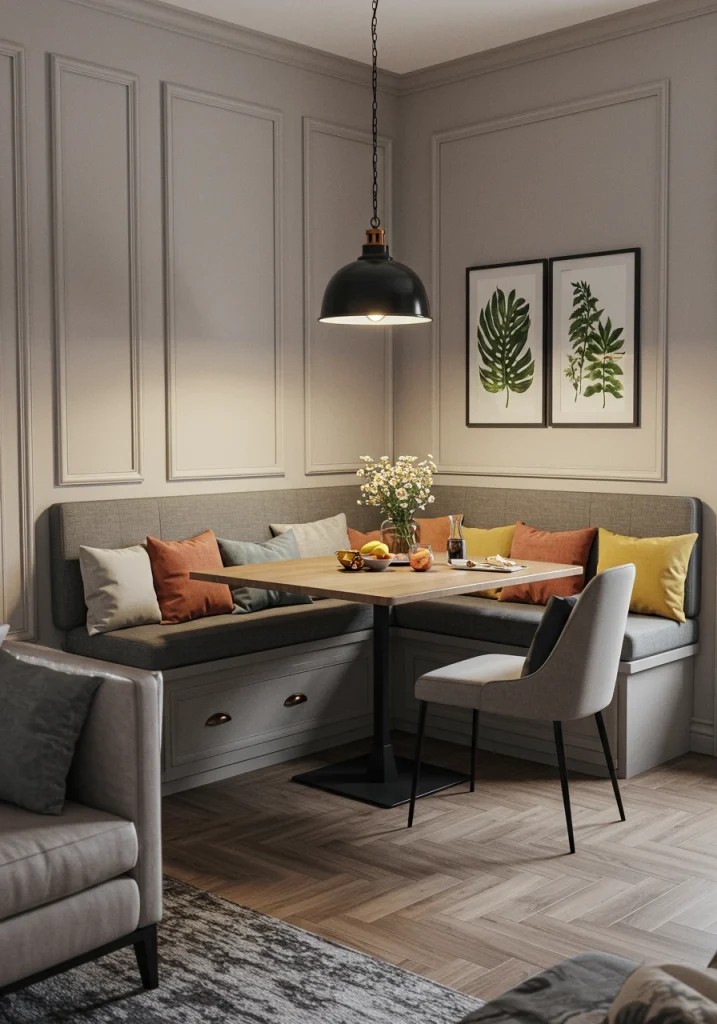
In many living room kitchen combos, there’s an awkward transitional space that is meant for a dining table but can be difficult to furnish. A built-in banquette, or booth-style seating, is a fantastic, space-saving, and stylish solution. By building a bench directly against a wall, you can push your dining table closer to the wall, which saves a huge amount of floor space compared to having chairs that need to be pulled out on all four sides.
A banquette also provides a very cozy and intimate dining experience, reminiscent of a favorite cafe or restaurant. I love to design banquettes with a lift-top seat or drawers underneath to sneak in a huge amount of hidden storage.
- Space-Saving: Allows you to push your dining table closer to the wall, saving valuable floor space.
- Cozy Seating: Creates a comfortable and intimate dining nook.
- Storage Potential: The bench can be designed with hidden storage underneath.
For a comfortable and stylish enhancement, add a custom, upholstered seat cushion and a collection of comfortable throw pillows to your banquette. This adds softness, color, and makes it an even more inviting place to linger.
19. Use a Half-Wall Divider
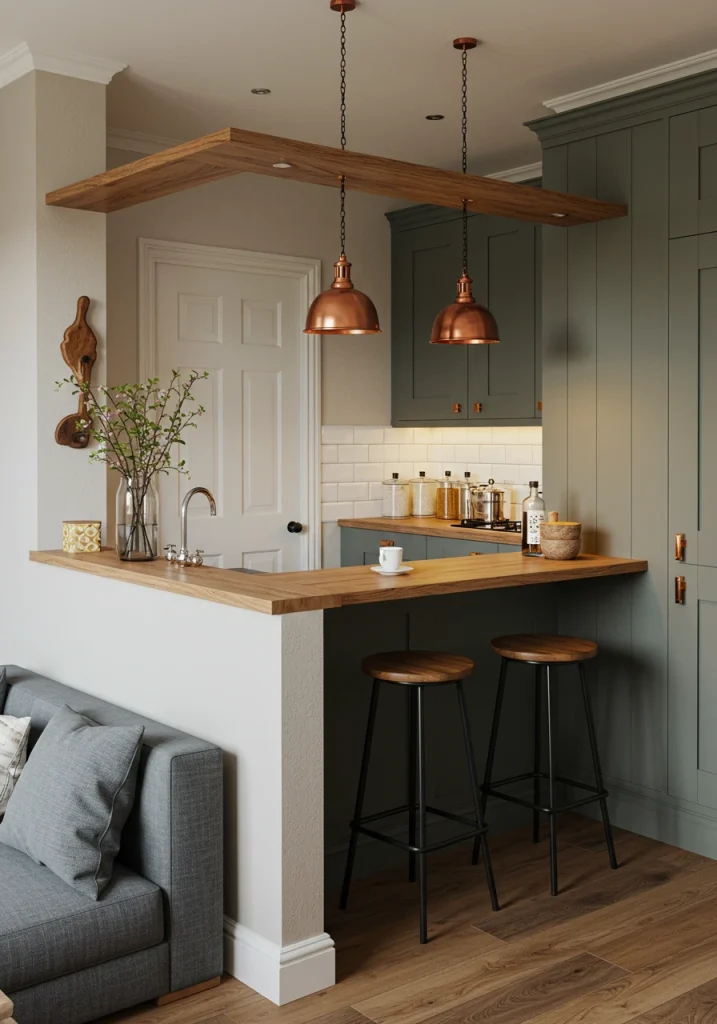
A half-wall is a fantastic and very practical way to create a solid sense of separation between your kitchen and living room without sacrificing the open, airy, and light-filled feel of an open concept. A half-wall, typically built to counter-height, provides a substantial, physical barrier for the messier, working side of the kitchen, while still allowing for easy conversation and a clear sightline across the top of the room.
This is a great compromise for clients who want an open feel but don’t want to be looking at their dirty dishes from the sofa.
- Hides Kitchen Mess: The solid lower portion can hide the clutter on your kitchen counters.
- Provides a Surface: The top of the half-wall can be capped with a countertop to create a serving bar or a display ledge.
- Defines the Space: Creates a very clear, architectural division between the two zones.
For an enhancement, design your half-wall to be a “waterfall” design. This is where you use the same, beautiful stone or quartz from your kitchen countertops for the top of the half-wall and have it flow seamlessly down the side of the wall to the floor. It’s a very high-end and contemporary look.
Conclusion
Mastering your open concept kitchen living room layout is about creating a thoughtful balance between a seamless, airy flow and a comfortable, functional definition of space. As we’ve explored through these 19 ideas, a successful open-plan design is a sophisticated composition of clever zoning strategies and cohesive design elements.
By using tools like kitchen islands, large area rugs, and strategic furniture placement to define your zones, and then tying the whole space together with a consistent color palette, flooring, and lighting plan, you can create a “great room” that truly lives up to its name.


